complex analysis functions
Bounded, Therefore Constant
A function can be continued beyond an observed region only because it belongs to a class that constrains every extension. Complex analysis makes the constraint exact; a fitted curve should disclose when it does not have one.
- You are seeing
-
- A smooth fitted curve is projected beyond the last observation
- A valuation model supplies values inside a missing interval with no structural assumption
- Two models agree in sample and diverge immediately outside it
- A complex expression is treated as a function without a stated domain or branch cut
- A continuation is reported as one value rather than a range across alternative classes
- The mechanism
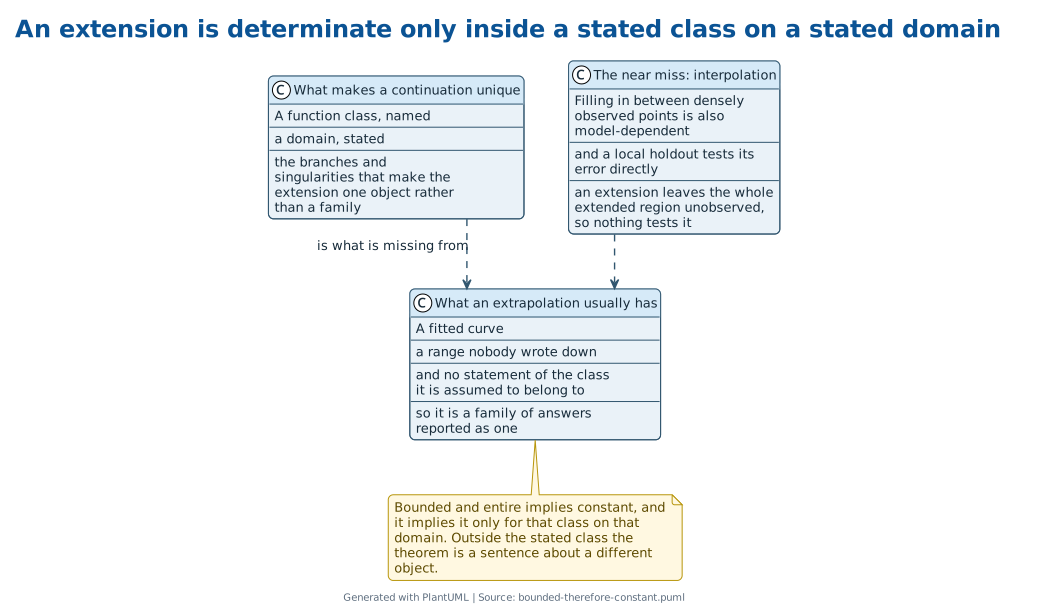
- Complex analysis makes continuation unique only within a holomorphic function class on a stated domain, while function classification fixes the domain, range, branches, and singularities that make an extension a determinate object.
- The older apparatus
- Complex analysis imposed holomorphicity, domains and singularity conditions before analytic continuation, while function references require a domain and branch choice before treating an expression as a function.
- The false friend
- Interpolation inside densely observed data can also be model-dependent, but local holdouts directly test its error rather than leaving the entire extension unobserved.
- The discriminating test
- State the function class and its domain, then perturb the unobserved region with alternatives that preserve observed fit; wide divergence means the extension came from the model choice.
- On your own data
- Require every extrapolation to declare domain, structural class, singularity or break assumptions and out-of-sample alternatives, then publish a range rather than one continuation.
In 1844 Cauchy proved that a bounded entire function is constant. Liouville published the same statement about elliptic functions three years later, and the theorem took Liouville’s name.
The naming is the least useful thing about it. The conditions are where the work happens.
Entire means holomorphic on the whole complex plane. Bounded means one finite ceiling applies everywhere, not merely across the part somebody happened to inspect. Given both, Cauchy’s estimate forces the first derivative to vanish at every point, and there is no room left for a non-constant extension.
That is what a continuation is when it has earned the word. Not a curve carried past its last plotted point. The only member of a class still compatible with what has already been fixed.
One derivative fixes all the others #
Cauchy’s differentiation formula supplies every derivative at once, from a single contour integral. A holomorphic function is therefore infinitely differentiable and analytic: on every disk inside its domain it equals its own Taylor series. The Cauchy estimates make the constraint quantitative, bounding each derivative in terms of the function’s size on a surrounding circle and the radius of that circle.
This is not the ordinary relationship between a sampled series and a fitted line.
It is a class membership test with consequences attached. Complex differentiability at every point of an open domain has already excluded almost all possible local behaviour before anyone asks what the function does.
Real functions have no such guarantee. A real function can be infinitely smooth at a point and still fail to equal its Taylor series anywhere near it, and the standard counterexample has been in textbooks for a century. Holomorphicity closes that gap. Nothing in a data series does.
Agreement near a point can settle a whole domain #
The identity theorem gives the operational form. Two functions holomorphic on the same connected domain, agreeing on a set with an accumulation point inside it, agree everywhere on that domain.
A sequence of distinct agreement points converging inside the domain is enough. An open sub-region is far more than enough.
Analytic continuation runs on that fact, joining overlapping power-series expansions. Once two patches agree on an accumulating set they stop being two candidates. They are one function on the overlap, and where the continuation succeeds, one answer on the enlarged domain.
The domain is doing visible work in that sentence. The theorem does not say an agreement set authorises a value wherever somebody would like one. It says what follows on a connected domain under holomorphicity.
Remove those words and the conclusion stops being a theorem and becomes a preference.
The failures are part of the function #
Reference works do not record a formula and leave the rest implied. They record admissible inputs, outputs and failures, in the same entry, at the same level of prominence.
Arcsin has domain from minus one to one because sine was restricted before being inverted. The exponential has the whole plane for a domain and everything except zero for a range. The Gamma function excludes every non-positive integer, and its poles there are simple, with known residues.
The zeta function makes the distinction between an expression and the object it defines. Its series converges only to the right of one. Its analytic continuation is defined everywhere except a single simple pole. The continued function is not the series asserted further than it converges; it is a constrained object reached from the series, and the constraint is what makes it unique.
Singularities are therefore not caveats added after a result. They state which extensions remain legal.
The most compact failure is the logarithm. Before a branch cut is imposed it is not a function at all but a relation, since every nonzero input has infinitely many logarithm values. The square root has two. The principal branch that everyone uses is a choice among valid determinations, and the symbols do not carry it unaided.
An expression becomes usable as a function by carrying its domain and its determination along with it. Nothing else supplies them.
There is no identity theorem for a fitted sample #
Two valuation models can agree on every observed value and diverge the moment they reach an unobserved interval.
That divergence is not numerical noise around one true continuation. It is evidence that the continuation came out of a chosen structural class — a growth rule, a singularity assumption, a branch convention, an assumption that no break occurs — and that the two models chose differently.
There is a nearby problem worth keeping separate. Interpolation inside densely observed data is also model-dependent, and it can be tested, because a local holdout is available. Beyond the last observation the entire target region is the holdout.
A curve can pass every in-sample check ever devised and still have no test at all of the part it is being used to supply.
And complex analysis has a constraint no financial series possesses. A holomorphic function cannot change regime halfway across a connected domain and remain the same holomorphic function. That is not a convention; it is the content of the theorem.
A market changes regime whenever it likes.
A power series continues to exactly one function, and not because the series is well behaved. Because somebody named the class it belonged to before extending it.
A fitted curve names no class. It runs past the last observation on the strength of a shape, and the values it produces out there were manufactured by the assumption rather than measured. Which is perfectly usable, as long as the assumption is written on the chart next to them.
Questions
Why does a curve beyond the last observation not count as a result?
A fitted curve determines values beyond its observations only after a structural class has been chosen. Smoothness in the observed region does not select a unique continuation: different models can preserve the same in-sample fit and diverge immediately outside it. A defensible extrapolation therefore states its class, domain, break assumptions, and the range produced by credible alternative continuations.
What makes analytic continuation unique in complex analysis?
Uniqueness comes from holomorphicity on a connected domain, not from a plotted curve looking smooth. If two holomorphic functions agree on a set with an accumulation point inside their shared connected domain, the identity theorem makes them equal throughout that domain. Analytic continuation can therefore have only one answer when it succeeds, because overlapping power-series expansions cannot disagree there.
Can a missing interval be filled without making an assumption?
No. Filling an unobserved interval selects a rule even when the rule is left unnamed. A function reference records a domain, range, and singularity structure because these limit where and how an expression has values. A valuation or forecasting model needs comparable disclosures; otherwise the filled interval presents a model choice as though the observations had determined it.
Is a smooth function the same thing as a holomorphic one?
No. A holomorphic function is constrained far more strongly than a merely smooth real function. Cauchy's differentiation formula gives derivatives of every order from holomorphicity, and the function equals its Taylor series on every disk contained in its domain. Real smoothness alone does not supply that rigidity, so it does not justify the same continuation claim.
Why does a branch cut matter if the formula is already written down?
Because complex log z and square root z are not single-valued functions before a branch is chosen. Every nonzero input has infinitely many logarithm values, differing by 2πik, and two square-root values. Removing a ray, conventionally the negative real axis for a principal branch, makes one determination usable but also states where it is not defined.
How can two models agree on the data and still disagree on the forecast?
Observed data constrain the models only where observations exist. Outside that region, the chosen class supplies the additional constraint: its growth rule, singularities, branch choice, or break assumptions. When alternatives fit the observations and produce a wide spread beyond them, the spread identifies model dependence. Publishing one continuation hides that uncertainty; publishing the alternatives exposes it.
Sources
- "About the Identities and Visualizations," Wolfram Functions Site (secondary, 2026-08-13)
- "About the Project," NIST Digital Library of Mathematical Functions (primary, 2026-08-13)
- "Abramowitz and Stegun," Wikipedia · Wikimedia Foundation (tertiary, 2026-08-13)
- "Dirichlet function," Wikipedia · Wikimedia Foundation (tertiary, 2026-08-13)
- "Elementary function," Wikipedia · Wikimedia Foundation (tertiary, 2026-08-13)
- "Elliptic function," Wikipedia · Wikimedia Foundation (tertiary, 2026-08-13)
- "Handbook of Mathematical Functions: Abramowitz and Stegun," NIST · U.S. National Institute of Standards and Technology (primary, 2026-08-13)
- "Lambert W-Function," DLMF §4.13 (primary, 2026-08-13)
- "Weierstrass function," Wikipedia · Wikimedia Foundation (tertiary, 2026-08-13)
- G. H. Hardy, *Orders of Infinity: The 'Infinitärcalcül' of Paul du Bois-Reymond*, via Internet Archive · Internet Archive (secondary, 2026-08-13)
- Wikipedia, "Conformal map" · Wikimedia Foundation (tertiary, 2026-08-13)
- Wikipedia, "Inverse Laplace transform" · Wikimedia Foundation (tertiary, 2026-08-13)
- Wikipedia, "Joukowsky transform" · Wikimedia Foundation (tertiary, 2026-08-13)
- Wikipedia, "Liouville's theorem (complex analysis)" · Wikimedia Foundation (tertiary, 2026-08-13)
- Wikipedia, "Maximum modulus principle" · Wikimedia Foundation (tertiary, 2026-08-13)
- Wikipedia, "Morera's theorem" · Wikimedia Foundation (tertiary, 2026-08-13)
- Wikipedia, "Nyquist stability criterion" · Wikimedia Foundation (tertiary, 2026-08-13)
- Wikipedia, "Residue theorem" · Wikimedia Foundation (tertiary, 2026-08-13)
- Wikipedia, "Rouché's theorem" · Wikimedia Foundation (tertiary, 2026-08-13)