pseudohistory bayesian statistics
It Only Happened Once
Falsifiability was built for claims you can re-test. Historians replaced it with something else. Bayes handles single events natively and, at one observation, hands back your prior.
- You are seeing
-
- A track record consists of one outcome and a narrative
- A claim is defended as falsifiable in principle with no corroborating source
- A Bayesian framing is offered as though it removed the need for judgment
- A flat prior is described as making no assumption
- The mechanism
- A claim about a unique event cannot be tested by repetition, so the available tests are corroboration across independent sources and explicit prior-plus-update — and at one observation the second returns the prior with arithmetic attached.
- The older apparatus
- Historiography, which abandoned falsifiability for single events and built a corroboration procedure instead, in 1898. Bayesian statistics supplies the arithmetic and is explicit about what dominates it when data is scarce.
- The false friend
- A single event drawn from a repeatable class. One coin flip is not a unique event; one merger integration might be. The distinction is whether comparable cases exist, not whether this instance recurred.
- The discriminating test
- Ask how many independent sources would have to be wrong for the claim to be false. If the answer is one, no amount of Bayesian framing changes the evidential position.
- On your own data
- For single-realisation claims, record the prior explicitly before the update and check how much the posterior moves. Where movement is small, report the prior as the finding.
Popper’s criterion asks a claim to rule something out in advance. State what observation would refute you, then go and look.
It works when you can look again. A physical law can be tested this year and next, by other people, in other laboratories, and the test means something because the experiment reruns.
A specific past event does not rerun. It happened once, under conditions nobody controlled, and no amount of methodological rigour produces a second instance to check against.
So historical method does not actually run on falsifiability, whatever it says in the introduction. Langlois and Seignobos set out the working procedure in 1898: corroboration. Where repeatability is unavailable, you substitute independent agreement among sources — accounts that could not have coordinated, agreeing anyway.
Which means falsifiability, applied to a historical claim, is necessary and not sufficient. A claim can be constructed so that some observation would count against it, and still fail, because no source corroborates it. Someone applying falsifiability alone as the test will pass claims that historical method rejects on entirely different grounds.
The other available answer #
Bayesian inference takes the single-event problem in its stride, which is genuinely its strongest suit.
There is no requirement for repetition. You hold a prior, an observation arrives, you update, and you have a posterior — a direct probability statement about the thing you care about rather than about a hypothetical long run of experiments you are not going to perform.
For a unique event this is the right shape of tool, and the alternative frameworks do not have an equivalent.
But the posterior is a weighted combination, and the weights depend on how much data arrived. The Bernstein–von Mises result says large samples wash out the prior — with enough observations, two analysts starting from different beliefs converge on the same answer, and the prior stops mattering.
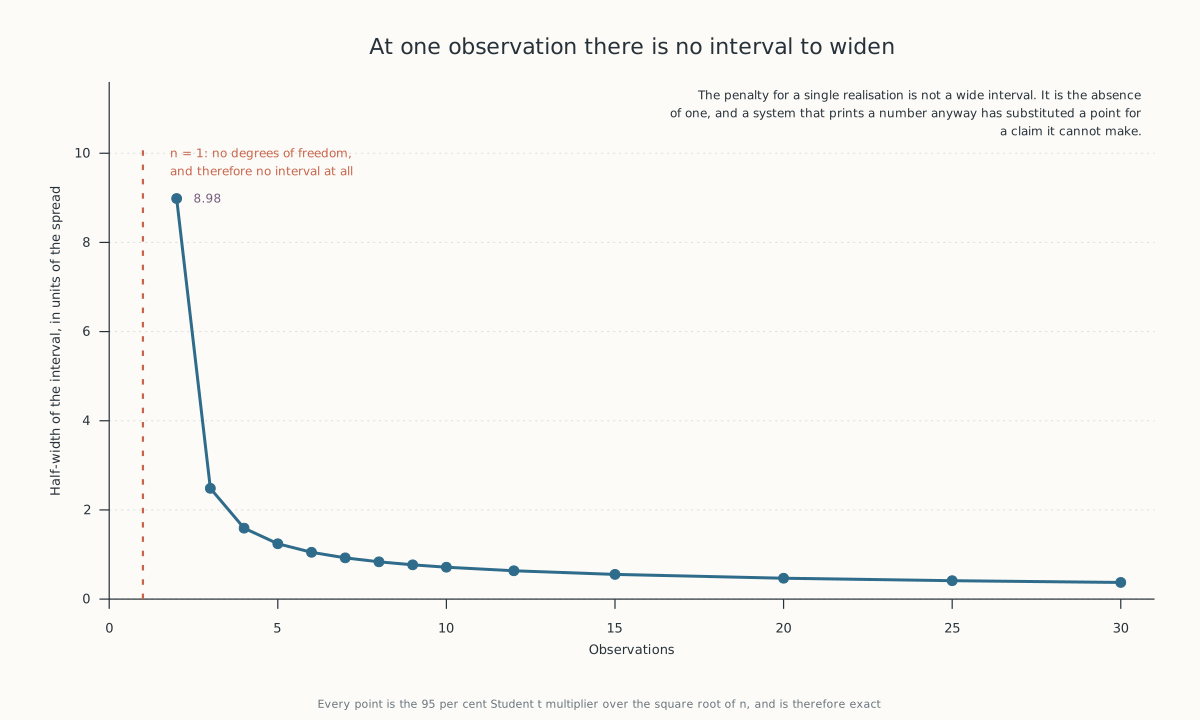
Read it in the other direction. With one observation, the prior is most of the answer.
That is not a defect in Bayesian statistics. It is Bayesian statistics correctly reporting the evidential situation: one data point does not contain much, and a framework that pretended otherwise would be broken. But it does dispose of the idea that adopting the machinery improves your position on a single-realisation claim. What you get is your prior, with arithmetic attached, expressed to more decimal places.
The benefit is real and it is a different benefit. The prior had to be written down.
The prior that claims not to be one #
Which is where the last trapdoor sits.
A flat prior gets described as uninformative, neutral, or assumption-free, and it is none of these. It is the specific claim that all values are equally likely, which is a strong statement in most settings and one that does not survive reparameterisation — flat in one coordinate system is not flat in another, so “no assumption” cannot be a property of it.
Choosing a flat prior is a judgment. Calling it uninformative makes the judgment less visible without making it smaller, and in sparse-data settings, where the prior dominates, it is the judgment doing nearly all the work.
What this looks like with money #
A strategy has run once, through one regime, and produced one outcome. A fund manager has integrated one acquisition. A model has been through one stress event.
The claim under evaluation is that the outcome reflects skill, or that the approach generalises. It is a single-realisation claim and all three tests apply.
Falsifiability passes and tells you nothing. Yes, some future result would count against it. That is true of almost any claim anyone makes, and the criterion does not discriminate here.
Corroboration is the test that does work, and it is rarely run. How many genuinely independent accounts of what happened exist, and could they have coordinated? A track record, an attribution analysis produced by the same team, and a client reference sourced by that team are not three sources. Langlois and Seignobos would have counted them as one.
And the Bayesian version is worth doing precisely because it fails informatively. Write the prior down first — what did you believe about strategies of this type before this instance. Then update. Then look at how far the posterior moved.
Where it barely moved, that is the result. The evidence was one observation and it did not carry much, and the number you are now holding is a formalisation of what you already thought.
Reporting that honestly is more useful than a test that returns “not refuted,” because it names the input actually carrying the conclusion — the prior — and puts it where somebody can disagree with it.
There is one thing to check before any of this applies. A single event drawn from a repeatable class is not a unique event — one coin flip belongs to a population of coin flips, and the ordinary machinery works fine. The question is whether comparable cases exist, not whether this one recurred.
Most of the time in markets they do exist, and nobody went to find them, because the narrative arrived first and it was about this instance.
Questions
Why doesn't falsifiability work for historical claims?
Popper's 1934 criterion asks that a claim exclude some possible observation in advance, which works when the experiment can be run again. A specific past event happened once and cannot be rerun under controlled variation. Falsifiability remains necessary but is not sufficient — a claim can be structured so that evidence would count against it and still fail for want of any corroborating source.
What did historians use instead?
Langlois and Seignobos set out a corroboration procedure in 1898, substituting independent agreement among sources for repeatability. Where you cannot run the event again, you ask whether accounts that could not have coordinated agree. It is the working test of historical method, and it is doing the job falsifiability does elsewhere.
Does Bayesian inference solve the single-event problem?
It handles it natively, which is not the same as solving it. Bayes gives a coherent way to update on one observation. But the posterior is a weighted combination of prior and likelihood, and with one data point the prior carries most of the weight. Large samples wash out the prior; one observation does the opposite.
Is a flat prior neutral?
No, and treating it as neutral is a named error. A flat prior is a specific assumption — that all values are equally likely — which is a strong claim in most settings and is not preserved under reparameterisation. Choosing it is a judgment like any other, made less visible by being called uninformative.