mathematical constants
Still Five Significant Figures
A number that follows from a definition, a number settled by measurement, and a number that depends on an unstated choice get printed to the same decimal place. Asking what more effort buys separates all three.
- You are seeing
-
- Two desks produce different values for the same named quantity and neither is wrong
- A figure that depends on a curve or day-count choice is quoted without naming it
- A definitional value and an estimated one are printed to the same number of decimals
- A quantity is described as the industry standard and has three live definitions
- A dispute about a number turns out to be a dispute about which number was meant
- The mechanism
- Quantities that follow from a definition, quantities settled by measurement, and quantities that vary with an unstated convention are reported in identical form, and only the second has a notation for how far it can be trusted.
- The older apparatus
- Constant curation, which excludes measured quantities from its population on a stated principle rather than by degree, and which says out loud that its own boundary is a habit among curators rather than a theorem.
- The false friend
- Ordinary estimation error, which is real, bounded and reportable. A spread produced by different convention choices is not error, because nobody measured anything wrongly, and it does not shrink with effort or sample size.
- The discriminating test
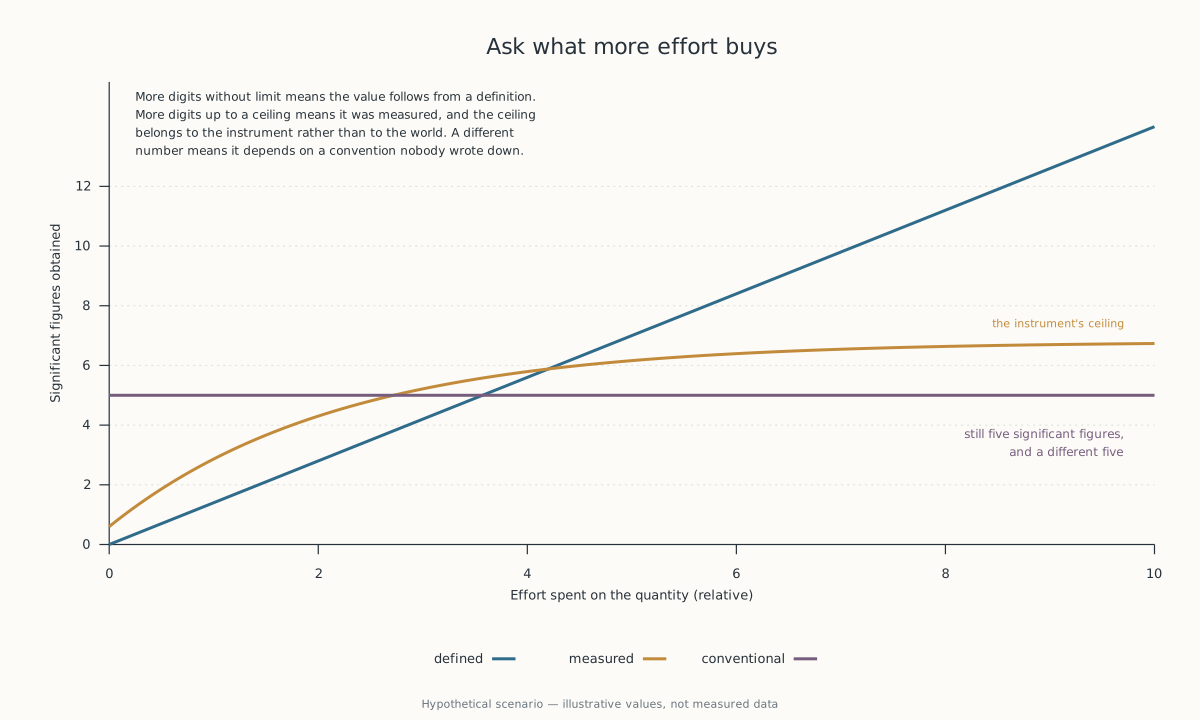
- Ask what more effort buys. More digits without limit means the value follows from a definition. More digits up to a ceiling means it is measured and the ceiling belongs to the instrument. A different number means it depends on a choice nobody stated.
- On your own data
- Take one reporting pack and label every number as computed, measured or chosen. Then check how many of the chosen ones carry the convention they depend on anywhere in the document.
The gravitational constant has been measured for something over three centuries and is known to about five significant figures.
Every refinement has bought a little more precision, and the ceiling has barely moved.
The digits of pi can be produced to whatever depth anyone is willing to pay for. There is no ceiling and there is not going to be one, because the digits follow from the definition rather than from an apparatus in a laboratory.
Those are two different kinds of number, and the difference is not one of degree.
The exclusion runs on a principle #
Curated lists of mathematical constants leave out the gravitational constant and the fine-structure constant, roughly 1/137.036, and not because those are less interesting or less recurrent.
Every constant on such a list is defined purely by mathematical objects — integers, limits, integrals — so its value follows necessarily from a chosen definition and can in principle be computed to arbitrary precision by pure reasoning. A physical constant is settled by measurement, carries experimental uncertainty, and could differ in a universe with different laws.
That is a boundary about how the value is obtained, not about how much anybody trusts it. Notation does not respect it at all. Catalan’s constant is conventionally written G, which is also the gravitational constant.
The third category carries no label #
Chaitin’s constant is presented, more or less everywhere, as a number: the halting probability, written as a specific real.
Its value depends entirely on the choice of universal prefix-free Turing machine used to encode programs. Different valid encodings produce different reals, all of them conventionally called Ω, and they need not agree past the first few digits.
The field says this plainly: there are infinitely many halting probabilities, one for each universal method of encoding programs, and it is common to use the one letter as though there were only one number.
Every member of the family is uncomputable, algorithmically random, normal and transcendental. They share every property anyone quotes about them, which is presumably why the singular label survived the imprecision.
What more effort buys #
Three kinds of number, and one question separates them. More digits without limit means the value follows from a definition. More digits up to a ceiling means it is measured, and the ceiling belongs to the instrument rather than to the quantity. A different number means the value depends on a choice that has not been stated.
The question costs nothing and it discriminates cleanly, which is more than most tests of this kind manage.
One column prints all three #
A coupon is definitional. A realised volatility is measured, and its ceiling is set by the length of the sample. A discount rate, a duration, a risk-free rate, an adjusted earnings figure — each of those is a family parameterised by a choice. Which curve, which tenor, which day-count, which adjustments, and against which comparator.
All of them appear at the same number of decimal places.
What kept Ω singular is what keeps these singular. The members of the family share the properties anybody quotes, so the label holds up almost all of the time, and the occasions it does not are the occasions that matter.
The boundary is a habit #
Nothing forbids calling zero, one, or one half a constant. Each is a perfectly well-defined fixed real number, and every curated list excludes them.
The exclusion is not a theorem. A number earns a place on these lists by being non-integral and by recurring across contexts its defining problem did not anticipate, and no source states that anywhere as a rule. It is visible only in what the lists actually contain.
So the population’s own boundary is a shared habit among curators, and the discipline records it as a habit instead of presenting it as a settled line. That disclosure is the part worth taking.
Error and disagreement have different notations #
The gravitational constant is known to five significant figures and it does not appear in a serious table without its uncertainty printed beside it. The uncertainty is part of the value.
That apparatus handles measured quantities, and it cannot represent chosen ones. A spread across desks using different curve conventions is not error. Nobody measured anything wrongly, nothing better will narrow it, and a larger sample does nothing at all. It is disagreement about which member of a family the name refers to.
There is no notation for that. Which means a chosen quantity ends up printed the way a computed one is, because the only alternative form available belongs to measurement.
The gravitational constant has been worked on for three centuries, is known to five significant figures, and never appears without its uncertainty next to it.
A discount rate is printed to two decimals with nothing next to it.
The spread across the people who would have picked a different curve is not an error bar, and there is no column for it.
Questions
What separates a mathematical constant from a physical one?
Not familiarity or importance. A mathematical constant is defined purely by mathematical objects — integers, limits, integrals — so its value follows necessarily from the definition and can in principle be computed to arbitrary precision by reasoning alone. A physical constant is settled by measurement, carries experimental uncertainty, and could in principle differ under different physical law. The gravitational constant is known to about five significant figures after centuries of work, a ceiling no mathematical constant faces.
Can a single named number turn out to be several numbers?
Chaitin's constant is the clean case. It is presented as the halting probability, a specific real. Its value depends entirely on the choice of universal prefix-free Turing machine used to encode programs, and different valid encodings produce different reals that need not agree past the first few digits. All of them are uncomputable, algorithmically random, normal and transcendental. Sharing every quoted property is presumably why one label stuck to a family.
How do you tell which kind of number you are holding?
Ask what more effort buys. If more computation returns more digits without limit, the value follows from a definition. If more measurement returns more digits up to a ceiling nobody has passed, it is measured and the ceiling is a fact about the instrument rather than about the quantity. If more effort returns a different number, the value depends on a convention that has not been stated. Pi answers the first way, the gravitational constant the second, and Chaitin's constant the third.
Is a spread across analysts the same as measurement error?
No, and the difference is why it does not shrink. Measurement error is reduced by better instruments and larger samples, and it has an established notation: the uncertainty is printed beside the value. A spread produced by different convention choices — which curve, which tenor, which day-count, which adjustments — is disagreement about which member of a family the name refers to. Nobody measured anything wrongly, and there is no error bar for a disagreement. The gravitational constant has both: centuries of refinement, a published uncertainty, and a ceiling around five significant figures.
Why are 0 and one half not on lists of constants?
By habit rather than by rule. Nothing in mathematics forbids calling them constants, and each is perfectly well defined. They are absent from every curated list because a number earns its place by being non-integral and by recurring in contexts its defining problem did not anticipate, and no source states that as a rule. It is visible only in what Finch's book, the OEIS index and MathWorld actually contain, which is a boundary the field describes as a shared convention among curators rather than a settled line.