topology non euclidean geometry
The Fish Do Not Shrink
Two objects can remain neighbours under a representation while the distances, angles and apparent densities are wrong. Topology supplies invariants; non-Euclidean geometry supplies the metric that the drawing hid.
- You are seeing
-
- A two-dimensional factor map makes clusters look evenly separated
- A network embedding is used to infer diversification distance
- A dashboard layout implies that adjacent risks are economically close
- A visual feature survives a redraw and is treated as proof that the underlying distances survived too
- A map-based allocation decision has no surviving native similarity or exposure matrix
- The mechanism
- Topology preserves connectivity and other invariants under deformation, while non-Euclidean geometry specifies curvature-dependent distance and area; an embedding can retain one structural property while misleading on another that a decision needs.
- The older apparatus
- Topology distinguishes invariants from coordinates, and non-Euclidean geometry requires a metric and curvature before it permits distance or area claims.
- The false friend
- A genuinely low-dimensional structure will preserve both neighbourhood and relevant distances across reasonable embeddings, which can be checked out of sample.
- The discriminating test
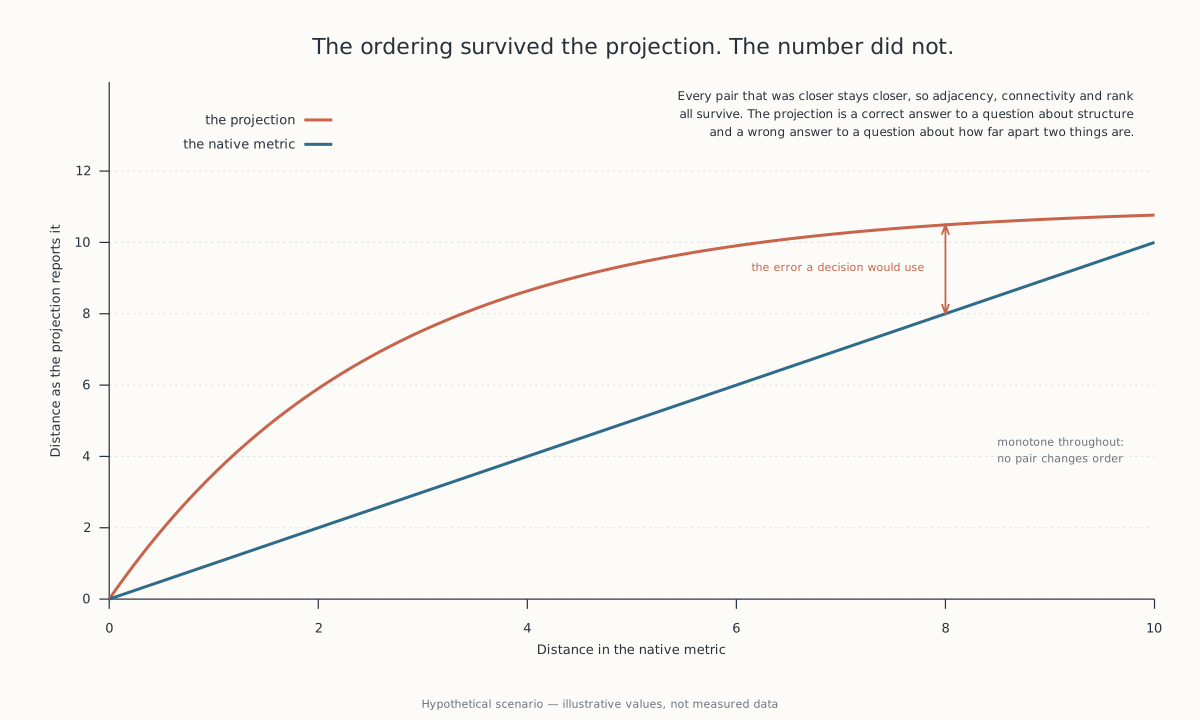
- Recompute the claimed separation under multiple embeddings and under the native distance or exposure metric; stability of adjacency but not distance identifies the representation error.
- On your own data
- Label every visual claim as topological or metric, retain the native similarity matrix, and require allocation decisions based on map distance to survive a metric-space reconstruction.
In 1959 M. C. Escher filled a circle with fish.
Circle Limit III is the third of four woodcuts he made between 1958 and 1960. The fish at the rim are tiny, and the gaps between them look tiny too. The natural reading is that the edge holds smaller copies of the fish packed into a smaller space.
It does not. The disk is a picture of a hyperbolic plane, where the fish stay congruent while the Euclidean drawing compresses them toward a boundary that is infinitely far away in the geometry being pictured.
Escher had seen the construction in H. S. M. Coxeter’s 1957 article on crystal symmetry, and in a letter the following year he named the figure that started the work: a tiling by triangles of 30, 45 and 90 degrees, a set of angles no Euclidean triangle can have.
The picture keeps a relation and throws away a measurement. That is precisely what makes it useful.
The disk preserves the arrangement and not the ruler #
The Poincaré disk is not defective because its rim lies. The lie is the instrument.
A bounded Euclidean disk holds an unbounded amount of hyperbolic distance, because distance stretches without limit as the boundary is approached. What looks dense in the drawing need not be dense in the space, and what looks adjacent may be arbitrarily far apart.
Non-Euclidean geometry states the missing ruler rather than hiding it. In the hyperbolic plane the circumference and area of a circle grow exponentially with radius rather than linearly and quadratically, so a circle of moderate radius already exceeds its Euclidean counterpart by orders of magnitude. A triangle’s area is fixed entirely by how far its angles fall short of a straight line.
Those are not decorative corrections to a familiar picture. They say that a length, an angle and an area are claims a reader may only make after the metric and the curvature have been named. A disk that leaves them implicit is a display rather than a measuring instrument.
Topology asks a narrower question on purpose #
Topology gets brought in after the fact because it keeps something solid while a shape bends. The solid thing is not distance.
The Euler characteristic of a triangulated surface does not depend on which triangulation was chosen. A sphere gives two, a torus gives zero, and those counts survive deformations that would render every coordinate and every drawn angle useless. For compact surfaces, orientability, Euler characteristic and boundary components classify the surface completely.
The classification is exact because it declines to say anything about how the surface sits on the page.
Land records apply the same restraint in software. A GIS topology model stores shared nodes, edges and faces, so that two adjoining parcels cannot hold separate coordinate lists for the boundary they have in common. It establishes that two parcels meet along the same edge. It has no opinion about which pair is economically near.
That is the first discipline any map owes a reader: say whether the claim is that two things connect, that they share a boundary, that a loop survives, or that they lie a certain distance apart. The first three are topological. The fourth has already left topology.
The bargain can be struck deliberately #
In 2010 Dmitri Krioukov, Marián Boguñá and Fragkiskos Papadopoulos reported that router-level Internet structure — heavily skewed degree distribution, strong clustering — corresponds naturally to hyperbolic rather than Euclidean geometry.
The operational payoff was greedy routing. A router uses its own coordinates and those of its immediate neighbours to forward a packet, holds no map of the whole network, and the local rule performs close to optimal path-finding.
That is the right geometry chosen for a stated task. It is not permission to read every visual separation as a physical length.
Nickel and Kiela made the same choice for symbolic data in 2017, placing the WordNet noun hierarchy in the Poincaré ball and reporting lower distortion than Euclidean embeddings of the same dimensionality. Hyperbolic space has room for an exponentially branching tree because its circles grow exponentially. A fixed-dimensional Euclidean space does not, and the tree has to be crushed to fit.
The result explains why the map can be good. It does not enlarge the set of questions the map is allowed to answer. Hierarchy, nearest relation and routing survive the embedding while the Euclidean distances visible on the screen remain the wrong quantities to feed a diversification calculation.
What survives the representation #
Persistent homology separates the two states without needing to be told which is which. It builds nested complexes as a scale parameter grows and records when components, loops and voids appear and disappear. A feature that persists across a wide range of scales counts as structure. One that appears and vanishes almost at once counts as noise.
That is a better question to ask a map than whether its clusters have clean outlines, because an outline is an artefact of a projection. A component surviving many scales has passed a structural test. The size of the gap around it still belongs to a metric, and the metric may well have been replaced when the data was flattened.
Here is where the transfer stops.
Escher’s disk has a curvature fixed before the first fish is drawn, so the distance the picture hides is recoverable exactly by anyone who knows what the curvature is. A learned financial embedding takes its metric from the sample and the objective. Change either and the neighbourhood itself can move, not merely the apparent distances within it.
Physical space supplies a ruler that sits outside the representation. The financial map usually has no such thing.
The clusters on the screen are the part everyone looks at, and they were produced by a projection somebody chose.
The native exposure matrix is the part nobody draws, and it is still what decides which positions move together on the day it matters.
Questions
Can a factor map show two risks as equally far apart when they are not?
Yes. A two-dimensional map can retain which observations are neighbours while distorting the distances between them. The Poincaré disk makes an infinite hyperbolic plane fit inside a bounded Euclidean circle by compressing distance near its edge. Equal-looking gaps on a financial map therefore establish no equal economic separation unless the map's distance is checked against the native exposure or similarity metric.
What does topological adjacency actually preserve?
Topological adjacency preserves a relationship such as connectedness or a shared boundary, not a measurement of length, angle, area, or economic exposure. PostGIS topology stores adjacent parcels through shared nodes, edges, and faces so the common boundary cannot silently diverge into two coordinate lists. That integrity rule establishes that the parcels meet; it does not establish how far apart two other places are or how costly a route is.
When does a hyperbolic embedding deserve to be taken seriously?
A hyperbolic embedding deserves attention when the underlying structure has hierarchical or strongly branching form and preserves the decision-relevant relationships outside the fitted display. Krioukov, Boguñá, and Papadopoulos reported in 2010 that Internet router structure maps naturally to hyperbolic geometry for greedy routing. Nickel and Kiela's 2017 Poincaré embeddings reported lower distortion for hierarchical data such as the WordNet noun hierarchy than Euclidean embeddings of the same dimensionality.
How can a team tell whether a dashboard's distance is real?
A team recomputes the claimed separation from the native similarity, correlation, or exposure matrix and compares it across reasonable embeddings and samples. Stable adjacency with unstable distance identifies a display property rather than a relationship suitable for allocation. A map may remain useful for locating a connected region or a persistent cluster, but a diversification claim requires the metric that gives the separation operational meaning.
Why does topology not validate a learned financial map by itself?
Topology validates only the structural property it is asked to preserve, such as connectedness, holes, or shared boundaries. Physical geometry has independently measurable curvature and distance; a learned financial embedding selects its metric from a sample and an objective. Changes in data, sampling, or training can therefore alter even the apparent topology, while a smooth-looking display continues to suggest a stable economic structure that is not present.
Sources
- Cornell Chronicle, "Taimina shares viral crocheting technique" (June 2019) (primary, 2026-08-13)
- NeurIPS Proceedings, "Poincaré Embeddings for Learning Hierarchical Representations" (Nickel & Kiela, 2017) (secondary, 2026-08-13)
- PMC, "Topological data analysis and topological deep learning beyond persistent homology: a review" (GUDHI, HERMES, D3R Grand Challenges, SARS-CoV-2 variant forecasting) · U.S. National Library of Medicine (primary, 2026-08-13)
- PostGIS documentation, "Topology" (node/edge/face primitives, planar enforcement, SQL/MM, TIGER) (secondary, 2026-08-13)
- ScienceDaily, "Mapping new paths for a stressed-out Internet" (Sept. 12, 2010) (secondary, 2026-08-13)
- Wikipedia, "Brouwer fixed-point theorem" (1911 citation, Hadamard 1910, Bohl 1904) · Wikimedia Foundation (tertiary, 2026-08-13)
- Wikipedia, "Circle Limit III" · Wikimedia Foundation (tertiary, 2026-08-13)
- Wikipedia, "Compact space" (open-cover definition of compactness) · Wikimedia Foundation (tertiary, 2026-08-13)
- Wikipedia, "Configuration space (physics)" (robot motion planning use of configuration space) · Wikimedia Foundation (tertiary, 2026-08-13)
- Wikipedia, "Elliptic geometry" · Wikimedia Foundation (tertiary, 2026-08-13)
- Wikipedia, "Fundamental group" (homotopy/homeomorphism invariance) · Wikimedia Foundation (tertiary, 2026-08-13)
- Wikipedia, "Genus (mathematics)" (Euler characteristic invariance under homeomorphism, as background for what an invariant is) · Wikimedia Foundation (tertiary, 2026-08-13)
- Wikipedia, "Great-circle navigation" · Wikimedia Foundation (tertiary, 2026-08-13)
- Wikipedia, "Heine–Borel theorem" (statement, Borel 1895, Cousin/Lebesgue/Schoenflies extensions to 1900) · Wikimedia Foundation (tertiary, 2026-08-13)
- Wikipedia, "Hyperbolic geometry" · Wikimedia Foundation (tertiary, 2026-08-13)
- Wikipedia, "Jordan curve theorem" (1887 attribution, Veblen/Hales controversy, 2005 formal proofs) · Wikimedia Foundation (tertiary, 2026-08-13)
- Wikipedia, "Network topology" (graph-theory application, distinct from mathematical topology) · Wikimedia Foundation (tertiary, 2026-08-13)
- Wikipedia, "Non-Euclidean geometry" · Wikimedia Foundation (tertiary, 2026-08-13)
- Wikipedia, "Persistent homology" (filtration-based definition, role in TDA) · Wikimedia Foundation (tertiary, 2026-08-13)
- Wikipedia, "Poincaré conjecture" (geometrization and the 3-manifold classification background) · Wikimedia Foundation (tertiary, 2026-08-13)
- Wikipedia, "Rapidity" · Wikimedia Foundation (tertiary, 2026-08-13)
- Wikipedia, "Shape of the universe" · Wikimedia Foundation (tertiary, 2026-08-13)
- Wikipedia, "Topoisomerase" (Lk = Tw + Wr, Type I vs Type II mechanisms) · Wikimedia Foundation (tertiary, 2026-08-13)
- Wolfram MathWorld, "Poincaré Hyperbolic Disk" (tertiary, 2026-08-13)