archaeological sites historical documents
The Jaw and the Cranium
The absence of a find can mean nonexistence, nondeposition, nonrecovery, destruction or misclassification. Site records and document history built separate checks because a blank field cannot tell you which one happened.
- You are seeing
-
- A company has no filing in a dataset and is treated as inactive
- A missing trade is assumed never to have occurred
- An absent field is imputed as zero without a retention audit
- A source is described as missing without separating ungenerated, unretained, inaccessible, unextracted, and observed-zero states
- Unprovenanced material is treated as fabricated, or fabricated material as merely unprovenanced
- The mechanism
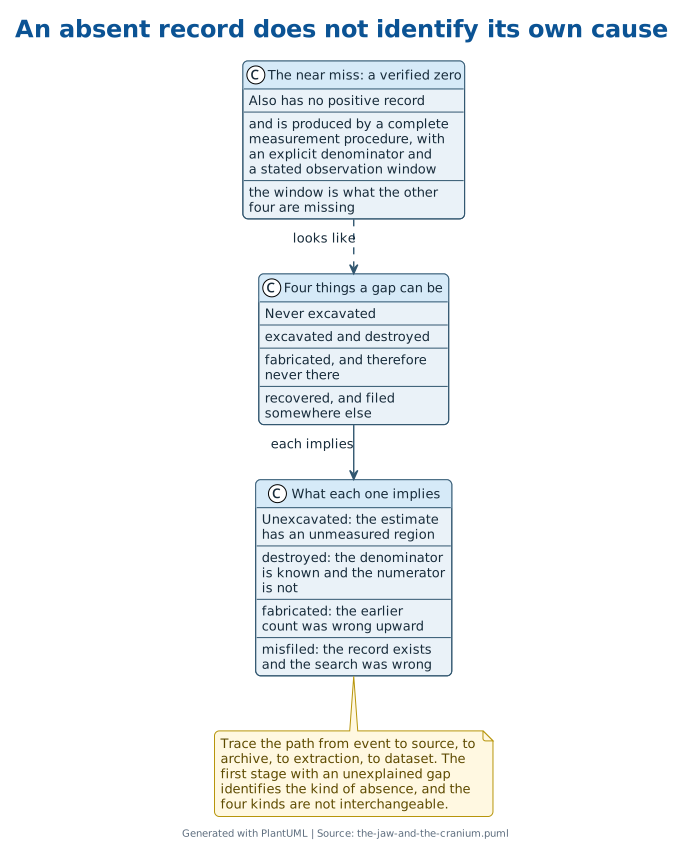
- Archaeological sites record whether material remains unexcavated, destroyed, fabricated, or recovered, while document history separates survival, authenticity, custody, and version because an absent downstream record does not identify its own cause.
- The false friend
- A verified zero also has no positive record, but it is produced by a complete measurement procedure with an explicit denominator and observation window.
- The discriminating test
- Trace the observation path from event to source, archive, extraction and dataset; the first stage with an unexplained gap identifies the kind of absence.
In 1912 Charles Dawson and Arthur Smith Woodward presented a skull and jaw from a Sussex gravel pit as the missing link between apes and humans. It was accepted for four decades.
In 1953 Kenneth Oakley, Wilfrid Le Gros Clark and Joseph Weiner ran fluorine absorption dating on it. The jaw and the cranium had spent dramatically different lengths of time in the ground.
The composite turned out to be a medieval human skull, an orangutan jaw a few centuries old, and chimpanzee teeth that somebody had filed down. A DNA review in 2016 traced teeth from two separate claimed discovery sites to the same individual orangutan.
Piltdown is not an absence. It is the opposite of one.
It is material made present under a false history, and it sat in the record looking exactly like evidence for forty years, because everything about its route into the collection had been supplied rather than observed.
That is worth holding next to the blank field, because the two failures are usually discussed as though they were the same problem.
Six histories, one empty cell #
The practical record starts well before any dataset.
An event may generate no source record at all. A source record may be generated and then not retained. Retained material may be inaccessible. Accessible material may be omitted by an extraction. An extracted field may be genuinely not applicable.
And only a completed observation procedure can establish an observed zero.
Six states, six different next questions, and a null value that represents all of them equally well. Represent every blank as null and the comparison has already been thrown away, before anyone gets to the imputation step.
An unopened site shows what the alternative looks like. The central tomb mound of the Terracotta Army has never been excavated, and the reason is documented: earlier exposure elsewhere degraded painted surfaces and organic material within hours.
There is no observation there, and there is a reason there, and the reason is on the record.
That blank means not yet opened, and it identifies why the ground is still available to somebody with better instruments in fifty years. It does not mean nobody looked, and it does not mean nothing is there. It is a decision, and it was written down as one.
Damage is not disappearance #
Destruction is another cause again, and it is not a synonym for never having existed.
The British Library holds a Magna Carta exemplification that was in the Cotton library when Ashburnham House caught fire in 1731. The parchment shrivelled and the seal melted. Later cleaning attempts left it largely illegible to the naked eye, and multispectral imaging has recovered only part of it.
Count what is actually in that record. An object exists. An institutional custody chain is intact. The text is damaged. A later reading is partial and dated.
Four separate facts, and the word missing collapses all four into one.
A researcher told the document is missing will stop. A researcher told the text is fire-damaged, the custody is continuous, and the last imaging attempt recovered part of it knows precisely what to try next, and knows what has already been tried.
The distinction is not pedantry about vocabulary. It is the difference between a dead end and a queue.
What the field register has that a table does not #
Archaeology sometimes creates absence deliberately and then documents the decision, which is a luxury the discipline earned by wrecking things first. Unopened ground is preserved by an explicit choice not to recover it yet, and the choice is published, argued over, and attributable to named people.
A digital source is not like that at all.
It can be collected and then purged, withheld, or dropped by an extraction without leaving anything behind but a blank field. It may leave an audit log. Nothing requires it to.
So the symptom matches exactly and the inspectability of the cause does not, which is the part that matters. In the field register, the reason for the blank is a document. In the table, the reason for the blank is usually gone, and it left at the same moment the data did.
That is an argument for an absence code rather than an argument for despair. Not generated, not retained, not accessible, not extracted, not applicable, observed zero. Six states, carried in the field, written at the point the blank is created rather than reconstructed afterwards by somebody guessing.
The code is not commentary on the data. It is what stops an inactive company, a never-executed trade, a withheld source and a failed delivery from arriving downstream as the same number.
Piltdown was believed for forty years because it filled a gap somebody badly wanted filled, and the test that killed it measured how long each piece had been in the ground — a question nobody thought to ask of a thing that was already sitting there, present, catalogued.
A null field asks nothing at all about what put it there.
Six different histories arrive in the same empty cell, and exactly one of them is a measurement. The other five are questions, and the code is the only thing that keeps them askable.
Questions
Does no filing in a dataset mean that the company is inactive?
No. A missing filing can mean that no filing was generated, that a generated filing was not retained, that it is inaccessible, or that an extraction did not capture it. Inactivity is only one possible explanation. The record needs a trace from the company event through the filing source and archive to the dataset before an absence is classified, and it needs an explicit observed-zero state before inactivity is inferred.
Does a missing trade prove that the trade never happened?
No. A missing trade record can result from nonexecution, nonreporting, retention failure, access restriction, or a failed extraction. Those causes have different consequences for exposure, volume, and surveillance. The first unexplained gap in the path from execution to the source system, archive, and delivered dataset identifies what the blank can support. Without that path, absence of a row is not evidence of absence of a trade.
When is it safe to treat a blank field as zero?
Only when a complete measurement procedure establishes a zero against a defined denominator and observation window. A blank produced by unavailable source material, a destroyed record, a withheld field, or an incomplete extract has no such meaning. Treating those states as zero combines noncomparable causes and makes later audits unable to distinguish nothing observed from nothing that happened.
Why would archaeologists leave a site unexcavated on purpose?
Archaeologists leave material unexcavated when opening it would expose or destroy evidence that later techniques may recover more safely. Göbekli Tepe was roughly 10% excavated in 2021 as part of a preservation strategy, and the central tomb mound of the Terracotta Army remains unopened because earlier exposure damaged painted surfaces and organic artifacts. An unexcavated area is therefore a recorded conservation decision, not a claim that nothing is there.
Is evidence without provenance automatically a forgery?
No. Missing provenance and fabrication are separate diagnoses. A fragment can lack a documented recovery path yet still require material and textual examination; a provenanced corpus can also contain forged inclusions. Around 2002, fragments sold as Dead Sea Scrolls material entered the market from undisclosed sources, while the Qumran material was recovered archaeologically between 1946 and 1956. The two routes make different claims available for checking.
Sources
- "A More Perfect Union: The Creation of the U.S. Constitution," National Archives (primary, 2026-08-13)
- "Bosnian pyramid claims," Wikipedia · Wikimedia Foundation (tertiary, 2026-08-13)
- "Code of Hammurabi," Wikipedia · Wikimedia Foundation (tertiary, 2026-08-13)
- "Cotton library," Wikipedia · Wikimedia Foundation (tertiary, 2026-08-13)
- "David Rubenstein," Wikipedia · Wikimedia Foundation (tertiary, 2026-08-13)
- "Dead Sea Scrolls," Wikipedia · Wikimedia Foundation (tertiary, 2026-08-13)
- "Donation of Constantine," Wikipedia · Wikimedia Foundation (tertiary, 2026-08-13)
- "Dorak affair," Wikipedia · Wikimedia Foundation (tertiary, 2026-08-13)
- "Dunlap broadside," Wikipedia · Wikimedia Foundation (tertiary, 2026-08-13)
- "Göbekli Tepe," Wikipedia · Wikimedia Foundation (tertiary, 2026-08-13)
- "Knossos," Wikipedia · Wikimedia Foundation (tertiary, 2026-08-13)
- "Machu Picchu," Wikipedia · Wikimedia Foundation (tertiary, 2026-08-13)
- "Magna Carta," National Archives (featured documents) (primary, 2026-08-13)
- "Museum of the Bible," Wikipedia · Wikimedia Foundation (tertiary, 2026-08-13)
- "Piltdown Man," Wikipedia · Wikimedia Foundation (tertiary, 2026-08-13)
- "Pompeii," Wikipedia · Wikimedia Foundation (tertiary, 2026-08-13)
- "Rosetta Stone," Wikipedia · Wikimedia Foundation (tertiary, 2026-08-13)
- "Stonehenge," Wikipedia · Wikimedia Foundation (tertiary, 2026-08-13)
- "Terracotta Army," Wikipedia · Wikimedia Foundation (tertiary, 2026-08-13)
- "Troy," Wikipedia · Wikimedia Foundation (tertiary, 2026-08-13)
- "Vinland Map," Wikipedia · Wikimedia Foundation (tertiary, 2026-08-13)
- "Çatalhöyük," Wikipedia · Wikimedia Foundation (tertiary, 2026-08-13)
- Magna Carta 1297, c.9, legislation.gov.uk (primary, 2026-08-13)