number systems mathematical notation
The Mark Survived
Digits can travel intact through a system while base, notation, unit or scope changes underneath them. Number systems and notation history separate the value, its representation and the convention that tells a reader how to recover it.
- You are seeing
-
- A percentage field is ingested as a decimal without metadata
- A price feed changes units and the digits still look plausible
- A spreadsheet export loses the base or scale of an identifier
- A numeric field survives a vendor transformation without its sign, locale or transformation convention
- The mechanism
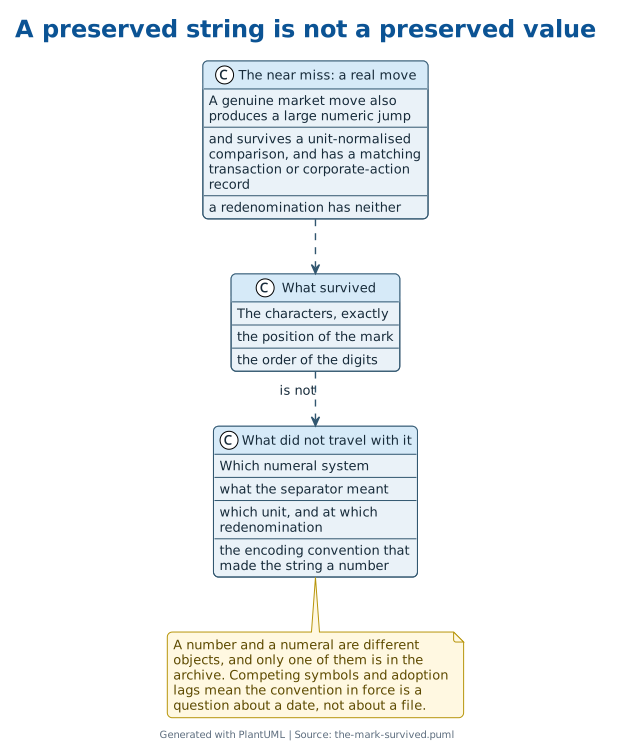
- Number-system work distinguishes a number from a numeral representation, while notation history records competing symbols and adoption lags; a preserved string is not a preserved value without its encoding convention.
- The false friend
- A genuine market move can create a large numeric jump, but it survives a unit-normalized comparison and has a corresponding transaction or corporate-action record.
- The discriminating test
- Round-trip the value through the source representation using declared base, scale, sign and unit; failures or alternative valid decodings indicate an encoding collision.
In 1706 William Jones printed π for the circle ratio in Synopsis Palmariorum Matheseos. In 1736 Euler fixed it to the modern 3.14 definition. Some authors went on using π for 6.28 until about 1761.
The mark survived. The value did not travel with it.
That reads as a quarrel in old mathematics, where the competing books can be put side by side on a shelf. It is also the ordinary failure of a number in transit. The field arrives. The digits are intact. The receiving system has lost the convention that says how to read them.
A numeral is not the thing it writes down #
The first distinction is older than any feed. A number system is a value-set with arithmetic structure. A numeral system is a way of writing numbers down. Roman numerals, tally marks and Egyptian hieroglyphs are the second kind, whatever casual usage calls them.
Roman numerals make the separation visible because they are so obviously incomplete. No place value. No clean representation of zero. No standard way to write a fraction, and no general algorithm for multiplying two of them directly.
Ancient and medieval users did the arithmetic on an abacus or a counting board and used the written numerals to record the result.
The written result was never self-sufficient, then. The board supplied the operation and the numeral supplied the record, and everyone involved knew which was which. A modern positional field looks more complete and carries exactly the same dependency: its digits become a value only inside a base and a place-value rule that are nowhere in the field.
Fixed-radix notation supplies the small version of the warning. 7 and 007 denote one integer. So do 0.999… and 1. A representation is not unique merely because every character survived the export.
A convention can move the boundary without touching a number #
Some of the most consequential numeric disagreements are not conversion errors at all. They are boundary declarations that have been mistaken for facts about the numbers.
ISO 80000-2 defines ℕ to include 0, and supplies ℕ* for the version that excludes it. Peano’s 1889 axioms began from 1. The inclusive convention spread from the 1960s, while a great deal of number theory and Anglo-American teaching still starts at 1.
Nothing has happened to zero.
What changed is the convention that says which integers a label covers. A dataset undergoes the same alteration when a field keeps its name and its digit format while the vendor changes the scope, the sign convention, the unit or the scale. The column stays legible for the same reason the change is invisible: the missing rule was never printed in the column.
Mathematics is unusually strict about marking which of its statements are theorems and which are conventions. That the real division algebras are the reals, the complexes and the quaternions is a theorem, proved by Frobenius in the 1870s. That ℕ contains 0 is a decision, made by a standards committee, revisable next revision.
A value, a representation of that value, and the declaration saying which structure is in force are three separate records. Losing the third does no visible damage to the first two.
A symbol’s record measures adoption, not permanence #
Notation history adds the second lesson. First print is not first use, and first use is not universal meaning.
Leibniz was using the ∫ shape in notebooks from 1675 and published it in Acta Eruditorum in 1686, an eleven-year gap between private use and public documentation. Newton was working with fluxion dots around 1666, published a partial account in 1693 and a fuller one in 1704. The record holds dates for documents. No instrument recovers the earlier private use.
The equals sign took longer than anyone would guess. Robert Recorde introduced = in The Whetstone of Witte in 1557, and it then vanished from print for sixty-one years. It gained ground in England from 1631 through Harriot, Oughtred and Norwood, and became standard across continental Europe only at the close of the seventeenth century. For part of that stretch, Descartes’s reversed proportional mark from La Géométrie was the commoner equality sign in European printing.
That is not readers failing to recognise two parallel lines. It is evidence that a mark and a convention are separable things, and that they separate routinely.
A character can be copied perfectly, placed in a document, and then read through a local rule the next document does not share. Jones’s π is the sharper case, because there the disputed convention was about what a familiar and universally recognised mark denoted.
What a conversion actually needs #
Once the representation is declared, conversion has exact rules and a checkable result: a source representation, a stated rule, and a value that can be taken back through the same rule to where it came from. The digits are one part of that statement, and not the part doing the work.
Operational feeds are less forgiving than mathematics on precisely this point. They mix vendor conventions without recording them, and the original scale is often gone before anyone notices the anomaly.
A percentage ingested as a decimal. A price feed whose unit changes at a version boundary. An export that drops an identifier’s base. Each leaves a plausible string behind.
Plausibility is the whole danger. An impossible value halts the process and gets investigated. An alternative valid decoding keeps everything moving.
Jones’s mark is three centuries old and has never changed shape.
What it denoted changed twice inside its first sixty years, and both times the mark crossed over intact while the meaning stayed behind. A feed repeats that every day. The digits arrive, the rule for reading them is not a field, and nothing downstream is built to notice when it fails to turn up.
Questions
What does it mean when a percentage arrives as a decimal?
It means the digits have arrived without the scale that makes them interpretable. A percentage and its decimal form can carry the same economic quantity only when the scale convention is declared. Without that declaration, both readings remain plausible and downstream calculations can be consistently wrong. The remedy is to retain the source scale as field metadata and round-trip the stored value through it.
Why can a price feed look plausible after its units change?
Because a bare numeral does not carry its unit. A feed can preserve every digit while changing the convention that says whether the field is expressed in one unit, another unit, or a scaled form, leaving a value that still resembles a possible price. Unit-normalized comparison and a matching transaction or corporate-action record separate an encoding collision from a genuine market move.
What is lost when a spreadsheet export drops an identifier's base or scale?
The export loses the rule needed to recover the value from its written form. Number-system work distinguishes a numeral system, which writes a quantity, from a number system, which supplies the value structure. A positional string without its base or an identifier without its scale admits more than one valid decoding, so preserving the characters does not preserve the original value.
How can a team tell an encoding collision from a real numeric jump?
A collision fails reconstruction under the declared source base, scale, sign and unit, or yields alternative valid decodings when one of those conventions is missing. A real jump survives a comparison after both observations are normalized to the same unit and has a corresponding transaction or corporate-action record. The difference is not how surprising the magnitude looks; it is whether the representation can be recovered.
Why is a numeric convention part of the data rather than a display choice?
Because the same mark can retain its form while its agreed interpretation remains unsettled. William Jones printed π for the circle ratio in 1706; Euler adopted the modern 3.14… definition in 1736, while some authors still used π for 6.28… until about 1761. The symbol travelled, but the convention needed to read it did not travel uniformly.
Sources
- "Bijective numeration," Wikipedia · Wikimedia Foundation (tertiary, 2026-08-13)
- "Frobenius theorem (real division algebras)," Wikipedia · Wikimedia Foundation (tertiary, 2026-08-13)
- "Hurwitz's theorem (composition algebras)," Wikipedia · Wikimedia Foundation (tertiary, 2026-08-13)
- "Hypercomplex number," Wikipedia · Wikimedia Foundation (tertiary, 2026-08-13)
- "Natural number," Wikipedia · Wikimedia Foundation (tertiary, 2026-08-13)
- "Optimal radix choice," Wikipedia · Wikimedia Foundation (tertiary, 2026-08-13)
- "Sedenion," Wikipedia · Wikimedia Foundation (tertiary, 2026-08-13)
- "Surreal number," Wikipedia · Wikimedia Foundation (tertiary, 2026-08-13)
- Wikipedia, "Division sign" · Wikimedia Foundation (tertiary, 2026-08-13)
- Wikipedia, "Equals sign" · Wikimedia Foundation (tertiary, 2026-08-13)
- Wikipedia, "History of mathematical notation" · Wikimedia Foundation (tertiary, 2026-08-13)
- Wikipedia, "History of the function concept" · Wikimedia Foundation (tertiary, 2026-08-13)
- Wikipedia, "Integral symbol" · Wikimedia Foundation (tertiary, 2026-08-13)
- Wikipedia, "Leibniz–Newton calculus controversy" · Wikimedia Foundation (tertiary, 2026-08-13)
- Wikipedia, "Mathematical notation" · Wikimedia Foundation (tertiary, 2026-08-13)
- Wikipedia, "Pi" · Wikimedia Foundation (tertiary, 2026-08-13)
- Wikipedia, "Square root" · Wikimedia Foundation (tertiary, 2026-08-13)