heraldry offices and titles
The Title Looked Continuous
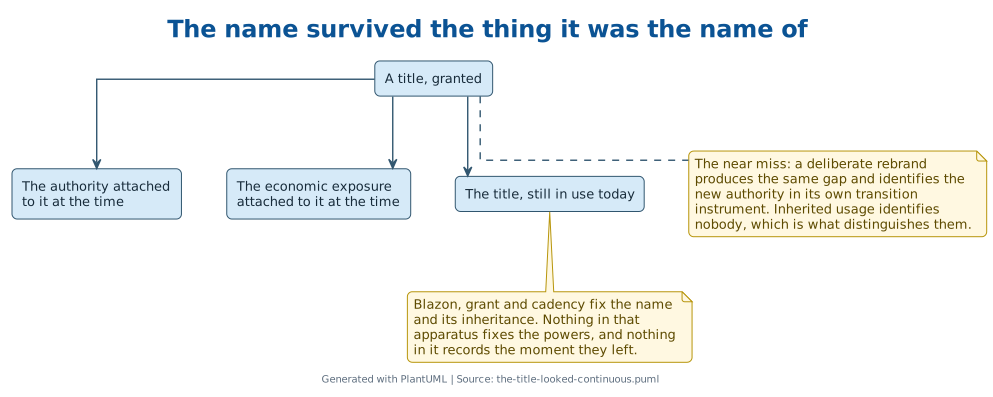
A formal label can preserve rank, precedence and a chain of usage after the authority behind it has moved elsewhere. Heraldry and office records make the entitlement and the name separate fields.
- You are seeing
-
- A desk name is used as a proxy for a mandate it no longer has
- A benchmark sector label implies a governance right that was moved to another committee
- An inherited product tier is treated as evidence of current capacity
- A legacy title is used to infer ownership, limits, or allocation rights without checking the current appointment record
- The mechanism
- Heraldry fixes a name and its inheritance through blazon, grant and cadency, while office records fix appointment, powers and precedence; a surviving title therefore does not establish that the authority or economic exposure once associated with it still travels with it.
- The false friend
- A deliberate rebrand can create the same gap, but its transition instrument identifies the new authority instead of relying on inherited usage.
- The discriminating test
- Trace the current powers, appointment route, effective date and allocation rights attached to the label; when they differ from the historical or marketing title, the title has outlived the office.
On 28 February 2013 Benedict XVI resigned the papal office. He kept the title Pope emeritus until his death in 2022, and Francis was the universally recognised reigning pope throughout.
The title looked continuous. The office was not.
Pope emeritus had no clean precedent. Earlier papal resignations had not left a former pope standing beside a sitting one under a continuing honorific, and the category was created by its only occupant.
It carried no rival claim. What it did was make a familiar mistake easy: reading a name derived from an office as evidence that the office, in some diminished form, was still attached to the person named.
A title can preserve precedence, memory and a chain of usage long after the authority that gave it meaning has gone somewhere else. That is not a curiosity of the papacy. It is the ordinary problem of reading formal names without their instruments.
The office is established by a different record #
The old English solution was to make the problem disappear by fiat. Blackstone’s formulation was that Henry, Edward or George might die, but the king survived them all. Under the demise of the Crown, kingship passed to the heir at once, with no interregnum, and reforms from 1695 onward stripped away the disruptive consequences a royal death had once carried.
That fiction made continuity explicit, which is the useful part. Most offices do not.
Their properties sit in separate records — a term in a consular list, a power in a narrative history, an oath, a statute, a removal procedure — and the title is usually the least informative of them.
A Doge of Venice could not open a foreign dispatch alone under the promissione ducale sworn at his election, and could not hold property abroad. The dignity named the holder. The oath limited the holder. Reading only the title supplies powers the office had deliberately withheld.
The Western Schism shows the opposite failure. From 1378 to 1417 Roman and Avignon lines both claimed the papacy, the Council of Pisa added a third claimant in 1409, and the Council of Constance ended the arrangement; later numbering excluded the losing lines as antipopes.
A title did not settle who held the office while people were living through the dispute. It cannot settle what powers a present holder has after a committee or an appointment route has quietly changed them.
Heraldry keeps the name and the entitlement apart #
Heraldry is unusually plain about this, because it has to make a distinction survive a very long chain of bearers.
A blazon is the legal description of arms rather than the painting. It begins with the field, names principal and secondary charges, and leaves crown, helmet, supporters and motto until last. Azure, a bend Or is a complete blazon. An artist can repaint it three centuries later without producing a new coat of arms.
None of which tells a reader who presently has the right to bear it. That takes a grant and a descent record, and in England the sequence is strict.
A memorial goes to the Earl Marshal, who issues a warrant under powers dating from 1673. Only then does a King of Arms draft the blazon, produce Letters Patent on vellum, seal it, and enter it in the register.
The order makes the separation visible. The blazon fixes the nameable object. The Letters Patent establish the entitlement. The warrant identifies the approval. The register preserves the chain.
A crest or a family name signals rank to a casual reader. None of them substitutes for the instrument saying who may hold what.
Inheritance moves the entitlement, not the name #
Cadency exists because one coat cannot be allowed to identify every descendant as the same bearer. England provides marks keyed to birth order — a label for the eldest, a crescent for the second, a mullet for the third — and the College of Arms describes their use as optional and sparse. The base arms can therefore survive with almost no visible evidence of which person is being described.
Scotland makes the separation harder to evade. Every later bearer must matriculate an individually differenced coat in the Public Register of All Arms and Bearings, continuously active since 1672. The original grant supplies the ancestry. The later matriculation supplies the current entitlement, and it is a separate act by a separate hand.
That is much closer to what a financial organisation needs than a title hierarchy is. A desk keeps a historic name while appointment, decision rights, limit ownership and allocation rules move elsewhere. A benchmark keeps an inherited sector label while the committee holding governance authority changes underneath it. A product tier keeps the rank its old name implied after its capacity and operating remit have changed.
Each case needs the current record rather than a reading of the display name.
The heraldic error costs nobody anything #
Heraldry’s distinction can stay entirely ceremonial. A wrongly-borne coat of arms embarrasses somebody. It does not move money, and the Earl Marshal’s register was never tested against anybody with a reason to misread it.
A financial label is different in kind, because it executes. It triggers a mandate, releases a limit, or authorises a payment, and it does so automatically, on the strength of the name, before anyone consults the appointment record.
That is why the gap matters more here than it ever did in the College of Arms. The heraldic version of the error produces a false impression.
Pope emeritus preserved an honorific after the office had passed to someone else, and nothing turned on it.
A surviving label preserves the old authority just long enough for a decision to be made under it, and by then the decision has already been made.
Questions
Does a senior-sounding desk name show who can make the decision?
No. A title records a naming and precedence history unless a current appointment or delegation also attaches powers to it. In the College of Arms process, a King of Arms designs the blazon, but the Earl Marshal issues the warrant that authorizes a grant under declared powers dating from 1673. The visible title and the operative approval are separate records.
When does a benchmark sector label carry a governance right?
A benchmark sector label carries a governance right only when the current rules assign that right to the label or its holder. Formal rank alone is insufficient. The Venetian Doge held a title that suggested broad authority, yet the promissione ducale prevented the Doge from opening a foreign dispatch alone. A governance register has to record the current restriction as well as the title.
Can an inherited product tier prove current capacity?
No. Inheritance can preserve a recognized distinction while changing the entitlement attached to it. English arms descend under Letters Patent to legitimate male-line heirs without a further registration step in most cases. In Scotland, every later bearer matriculates a differenced version in the Public Register of All Arms and Bearings, active since 1672. The shared name does not establish identical status or authority.
What record shows that an old label no longer owns the mandate?
The decisive record names the current holder, appointment route, powers, effective date, and allocation rights. A blazon alone cannot supply those facts: it is a controlled description of arms, ordered from field to charges to external ornaments. The office record must be read separately, as the Roman fasti record consular terms and a constitutional text records a defined removal mechanism.
Sources
- "Blazon," Wikipedia · Wikimedia Foundation (tertiary, 2026-08-13)
- "Cadency," Wikipedia · Wikimedia Foundation (tertiary, 2026-08-13)
- "Canadian Heraldic Authority," Wikipedia · Wikimedia Foundation (tertiary, 2026-08-13)
- "College of Arms," Wikipedia · Wikimedia Foundation (tertiary, 2026-08-13)
- "Court of the Lord Lyon," Wikipedia · Wikimedia Foundation (tertiary, 2026-08-13)
- "Demise of the Crown," Wikipedia · Wikimedia Foundation (tertiary, 2026-08-13)
- "Doge of Venice," Wikipedia · Wikimedia Foundation (tertiary, 2026-08-13)
- "Earl Marshal," Wikipedia · Wikimedia Foundation (tertiary, 2026-08-13)
- "Holy Roman Emperor," Wikipedia · Wikimedia Foundation (tertiary, 2026-08-13)
- "Marino Faliero," Wikipedia · Wikimedia Foundation (tertiary, 2026-08-13)
- "Marshalling (heraldry)," Wikipedia · Wikimedia Foundation (tertiary, 2026-08-13)
- "Ordinary (heraldry)," Wikipedia · Wikimedia Foundation (tertiary, 2026-08-13)
- "Papal conclave," Wikipedia · Wikimedia Foundation (tertiary, 2026-08-13)
- "Pharaoh," Wikipedia · Wikimedia Foundation (tertiary, 2026-08-13)
- "Pope Benedict XVI," Wikipedia · Wikimedia Foundation (tertiary, 2026-08-13)
- "Pope emeritus," Wikipedia · Wikimedia Foundation (tertiary, 2026-08-13)
- "Roman consul," Wikipedia · Wikimedia Foundation (tertiary, 2026-08-13)
- "Roman dictator," Wikipedia · Wikimedia Foundation (tertiary, 2026-08-13)
- "Rule of Tincture," Wikipedia · Wikimedia Foundation (tertiary, 2026-08-13)
- "Tribune of the plebs," Wikipedia · Wikimedia Foundation (tertiary, 2026-08-13)
- "Twenty-Second Amendment to the United States Constitution," Wikipedia · Wikimedia Foundation (tertiary, 2026-08-13)
- "Wenceslaus, King of the Romans," Wikipedia · Wikimedia Foundation (tertiary, 2026-08-13)
- "Western Schism," Wikipedia · Wikimedia Foundation (tertiary, 2026-08-13)
- Court of the Lord Lyon, fee schedule page (secondary, 2026-08-13)