rituals experimental design
What the Protocol Severs
Randomization and blinding defend against different things and get treated as one precaution. Anthropology has a rule for keeping the stated reason apart from the working one.
- You are seeing
-
- A control is defended on general rigour rather than against a named failure
- Steps accumulate and none is ever removed because nobody knows what each prevents
- The stated rationale and the functional explanation are the same sentence
- A procedure is described as best practice with no account of what happens without it
- The mechanism
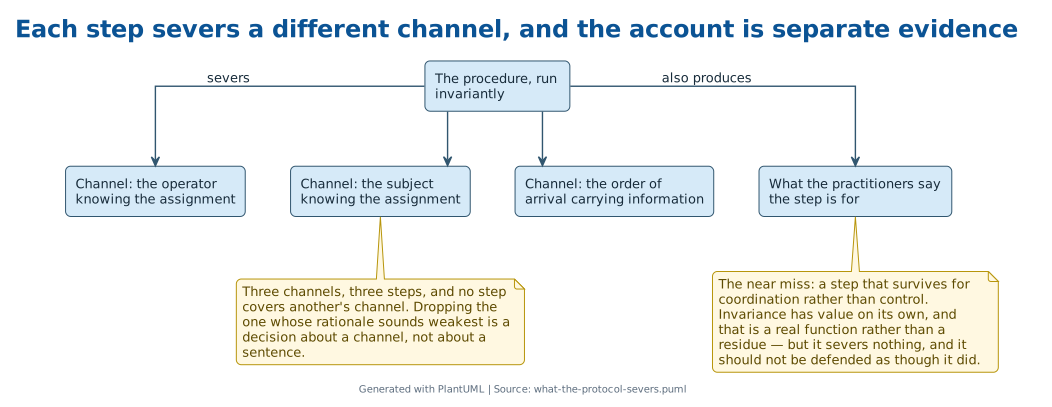
- An invariant procedure severs specific causal channels, and each step defends against a different one — but the practitioners' account of why a step exists is separate evidence from what the step actually does, and merging the two makes both unrecoverable.
- The older apparatus
- Experimental design names the channel each element severs. Ritual studies supplies the recording discipline: keep the practitioners' stated purpose distinct from any outside theory of function.
- The false friend
- A step that survives for coordination rather than control. Invariance itself has value independent of what any element severs, and that is a real function rather than a residue.
- The discriminating test
- For each step in a protocol, name the causal channel it removes and the failure that would occur without it. Steps with no answer are not thereby useless — they are unexamined, which is a different and recoverable state.
- On your own data
- Audit an execution or model-governance protocol step by step, recording the severed channel and the practitioners' stated reason in separate columns. The columns will not match, and the mismatches are the finding.
A randomized trial and a blinded trial are protecting against different things, and the two are routinely spoken of as one precaution.
Randomization acts at assignment. It removes the possibility that the groups differed before anything was done to them — that the healthier patients ended up in the treatment arm, that the better-behaved accounts ended up in the pilot. Once assignment is complete, randomization has finished working and provides nothing further.
Blinding acts after assignment, and it removes a different channel entirely. A participant who knows they received the real treatment may report improvement partly because they expect it. A clinician who knows may give the treatment group more attentive care, or read an ambiguous scan more generously. Neither has anything to do with what the treatment does; both change the measured result.
The two are independent and additive. A trial can be randomized and unblinded — many surgical and behavioural trials cannot blind anyone to what was done — and some of the most consequential trials in medicine were exactly that.
So the protocol is not one precaution. It is a list, and each item on the list names a specific route by which a result could be wrong.
The list nobody keeps #
That is the part that does not transfer.
Trading protocols, model governance procedures, investment committee processes and due diligence checklists all accumulate steps. Very few of those steps are documented against a named failure. They are defended as rigour, best practice, or what the regulator expects — defences that are available to every step and therefore distinguish none of them.
The consequence is that nothing is ever removed. A step whose purpose nobody can state cannot be safely deleted, because deletion requires knowing what it was preventing. So the list only grows, and the growth is indistinguishable from thoroughness.
Running the experimental-design question over an existing protocol is cheap and produces an immediate sort. For each step: what channel does this sever, and what would go wrong without it? Some steps answer instantly. Some do not, and the ones that do not are the interesting output — not because they are useless, but because they are unexamined, which is a recoverable state and a different one.
Why anthropology keeps two columns #
Ritual studies faces a harder version of the same problem and solved it with a recording rule rather than an analysis.
A ritual record keeps the participants’ own account of what the rite is for, and keeps it strictly separate from any explanatory theory a scholar applies afterwards. Aztec priests stated the purpose of sacrifice directly: life is because of the gods, and with their sacrifice they gave us life. That is an account of cosmic debt and maintenance. Protein acquisition and political theatre are scholarly interpretations layered on later, and both remain live disputes.
The discipline is to write the stated purpose down as stated, then write the functional theory somewhere else. Not because practitioners are always right about why they do things — often they are not — but because their account is separate evidence, and a theory that overwrites it has destroyed the data it was supposed to explain.
The Balinese Ngaben is stated in Balinese Hindu terms: releasing the soul from the body so it can reach the upper realm. The Green Corn Ceremony’s first-fruits offering is stated as atonement for the preceding year’s sins. Each of those is what the people doing it say it is for, recorded as such, available to be tested against what it appears to accomplish.
Two columns, applied #
Run both instruments over a protocol and you get a table with two columns that do not match.
One column is what each step severs — the causal channel, the failure prevented, the thing that would otherwise be able to happen. The other is what the people executing it say it is for.
Where the columns agree, the step is understood and can be reasoned about. Where the severed-channel column is empty and the stated-purpose column is full, you have a practice sustained by an account nobody has checked. Where the stated-purpose column is empty and the channel is real, you have a control that works and that nobody can explain, which is the state in which controls get removed during a cost review.
The mismatches are the output. Neither column alone produces them.
And a step with nothing in either column is not automatically waste. Invariance does work of its own: it removes discretion at moments when discretion is expensive, and it makes deviation visible. Ritual studies is comfortable with a rite whose function is that it is performed identically every time, by named roles, in a fixed order. That is a real answer.
What it is not is the answer you get by default, and the difference between having that answer and never having asked is the whole audit.
There is one further rule underneath all of it, and experimental design states it plainly: the design has to be fixed before the data arrives. Not because researchers are dishonest, but because a decision made after seeing the data cannot afterwards be shown not to have been influenced by it.
The protection is in the ordering. Which is also why it has to be dated, and why every discipline that takes it seriously ended up with a register.
Questions
What is the difference between what randomization and blinding protect against?
Randomization controls what happens at assignment, removing pre-existing differences between groups as a cause. It does nothing afterwards. Blinding removes knowledge of assignment as a causal channel — a participant who knows may respond to expectation, an assessor who knows may read an ambiguous result more favourably. The two are independent and additive, and a trial can be randomized without being blinded.
Why do anthropologists record the practitioners' stated purpose separately?
Because it is a different kind of evidence from a scholar's functional theory, and merging them destroys both. Aztec priests stated sacrifice as cosmic debt — life is because of the gods. Protein acquisition and political theatre are later scholarly interpretations. Recording the stated purpose keeps the practitioners' account available to be tested rather than replaced.
Does a protocol step need a named failure to justify it?
Not necessarily, but it needs an answer. A step with no identified channel may be doing real work through invariance itself — coordination, or the removal of discretion at a moment when discretion is expensive. What it cannot be is defended on general rigour, because that defence is available to every step and therefore distinguishes none.
Why must a design be fixed before data collection?
Because the guarantee comes from the ordering. A decision made after seeing the data cannot be shown not to have been influenced by it, regardless of the decider's intent. The protection is procedural, not psychological, which is why the fixing has to be visible and dated rather than merely honest.