chronology genealogy graph algorithms
The Eclipse, the Clerk, and the Checker
Three disciplines that will not take their own word for a result, and the three different things they each mean by independent.
- You are seeing
-
- A result is validated by re-running the process that produced it
- Two corroborating sources turn out to share an upstream origin
- Confidence in a chain rests entirely on one undated or unverifiable link
- Every individual record passes review and the set is still wrong
- The mechanism
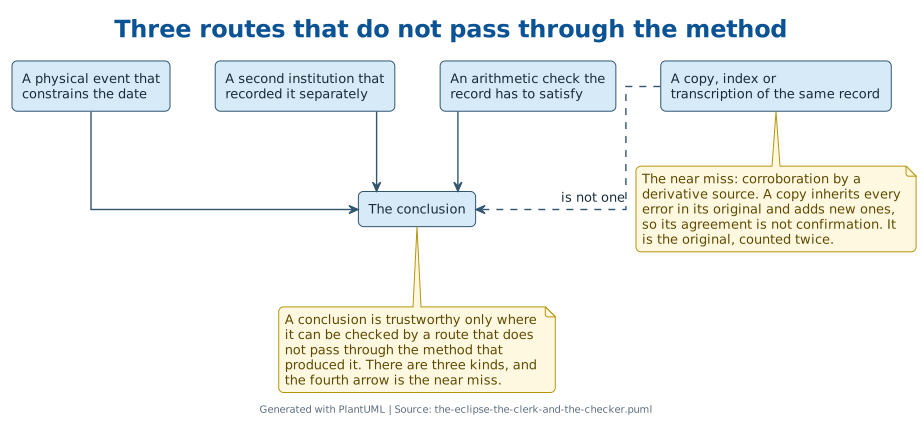
- A conclusion is trustworthy only where it can be checked by a route that does not pass through the method that produced it, and there are three distinct kinds of such route.
- The older apparatus
- Split three ways. Chronology owns independently recomputable anchoring, genealogy owns uncorrelated-error corroboration, graph algorithms own certificate checking. Each is invisible to the other two.
- The false friend
- Corroboration by a derivative source. A copy, index or transcription inherits every error in its original and adds new ones, so its agreement is not independent confirmation.
- The discriminating test
- For each link in the chain, ask what evidence would contradict it that does not come from the same source as the evidence supporting it. Links with no such route are unverified regardless of how well documented they are.
- On your own data
- Score any provenance chain on three axes separately — anchor recomputability, source independence, structural verifiability — and check whether the failures correlate. If they do not, single-axis audits are missing most of the risk.
The Assyrian king list is precise from 911 BCE and uncertain before it.
The reason is a solar eclipse. Assyrian records note one during the eponym of Bur-Sagale, and eclipses are not testimony — they are orbital mechanics. Anyone can compute which eclipses were visible from northern Mesopotamia in the ninth century BCE and find the one that fits. The chronicle stops being a claim about dates and becomes a claim that can be checked against the sky.
Everything before that point is a floating chronology: internally ordered, precisely spaced, and attached to nothing.
Three things “independent” means #
Chronology, genealogy and graph algorithms all refuse to take their own word for a result. They mean three different things by it, and the three do not substitute for each other.
Chronology means recomputable. The eclipse works because the verification route does not pass through the document. A written date tells you what a scribe wrote. An eclipse tells you what the solar system did, and the solar system did not have a position on Assyrian dynastic politics.
This is why the corpus distinguishes the eclipse anchor from the Venus tablet, which records observations that do not pin down a unique date the same way. Both are astronomical. Only one closes.
Genealogy means uncorrelated in its errors. The Genealogical Proof Standard requires reasonably exhaustive research, complete citations, analysis and correlation, resolution of conflicts, and a written conclusion. The reason all five are demanded rather than one strong record is that any record can be wrong invisibly. A clerk mistranscribes an age. An informant misremembers a birthplace. A marriage record with the wrong county on it looks precisely as authoritative as one with the right county.
Correlation works because independent records are wrong in different ways, so the errors cancel where the truth does not. Which produces the rule that matters most and gets ignored most: a derivative source — an index, an abstract, a transcription — inherits every error in its original and adds its own. It agrees with the original because it came from it. That agreement is not corroboration and looks exactly like corroboration.
Genealogists go further and classify within a source. A death certificate’s date of death is primary information from an attending physician. The birthplace field on the same certificate is often secondary, supplied by a grieving relative decades after the fact. Same page, same seal, different trust.
Graph algorithms mean checkable by a different computation. A shortest-path result is not verified by re-running the algorithm, which would reproduce whatever was wrong the first time. It is verified by reconstructing the path and summing its edges. A minimum spanning tree is verified against the cut and cycle properties, which any correct tree must satisfy no matter how it was built.
The checker is usually cheaper than the computation and shares none of its assumptions. That is the entire design requirement.
Why the three do not cover for each other #
Take a chain with a perfect anchor, perfectly resolved identities, and a structural error. The eclipse holds. Every record is independently sourced. The graph has a defect nobody tested for, and the chain is wrong.
Now take one with a checked structure and a fabricated anchor. Every property verifies. The whole thing is attached to a date somebody asserted.
Genealogy supplies the sharpest case of a set failing while its parts hold. A non-paternity event — an informal adoption never recorded as such, a concealed remarriage, a substitution at registration — produces a documentary record that is internally consistent and well sourced, because the people writing it down had no reason to write anything else. Every document passes review. The conflict appears only when genetic evidence is correlated against the whole set, and the base rate is not negligible: a 2005 review put the median around 3.7%, with later geneticists arguing for something closer to 2%.
Record-level review cannot find that. There is no defective record to find.
The audit that gets run #
Provenance work in finance — beneficial ownership, model lineage, data supply chains, collateral chains — is almost always audited on one axis.
Usually identity. Is this entity the entity we think it is, is the name matched correctly, has the record been checked. That is genealogy’s axis and it is a real one.
The anchor axis mostly goes unexamined. A chain of custody terminating in an attestation is not anchored; it is asserted. The question chronology asks is whether any link can be verified by a route that does not pass through the party attesting it, and the honest answer is often no.
The structural axis goes almost entirely unexamined, because it requires knowing what property the correct answer would have — and unlike a spanning tree, an ownership chain has no textbook certificate. Which is a reason to define one, not a reason to skip the check.
What to do with three axes #
Score them separately and look at whether the failures correlate.
If a chain that fails on identity also tends to fail on anchoring, one audit finds most of the risk and the current practice is roughly adequate. If the failures are independent — which is what three centuries of genealogical, chronological and algorithmic practice would predict, since each failure is invisible to the other two methods — then single-axis auditing is finding about a third of what is there and reporting it as a clean result.
Nobody has run that test on a real ownership register. It is a week of work and the answer is a number.
The Assyrians did not record the eclipse in order to be checked. They recorded it because it happened, and three thousand years later it is the only line in the document that cannot have been written to please anyone.
Questions
Why can an eclipse date an ancient king list when a written record cannot?
Because an eclipse is recomputable. Orbital mechanics let anyone calculate which eclipses were visible from a given location in a given century, so a recorded eclipse ties a floating sequence to an absolute date by a route that does not pass through the chronicle. A written date only tells you what the scribe wrote.
Why is a copy of a document not independent corroboration of it?
A derivative source — a copy, index, abstract or transcription — inherits every error already in the original and can add new ones in the copying. Two sources only cancel each other's errors if they are wrong in uncorrelated ways, and a derivative is wrong in exactly the same ways as its parent, plus some.
What does it mean to verify a computed result with a checker rather than by re-running it?
Re-running reproduces the original's bugs. A checker tests a property the correct answer must have, independently of how it was produced — a shortest path can be verified by summing the path's edges, and a minimum spanning tree by the cut and cycle properties. The check is cheaper than the computation and does not share its assumptions.
Can every document in a set pass review while the set is wrong?
Yes, and it is a documented pattern. In genealogy a non-paternity event produces a paper trail that is internally consistent and well sourced, because the people recording it had no reason to record anything else. The conflict only appears when genetic evidence is correlated against the whole set. Record-level review cannot find it.